
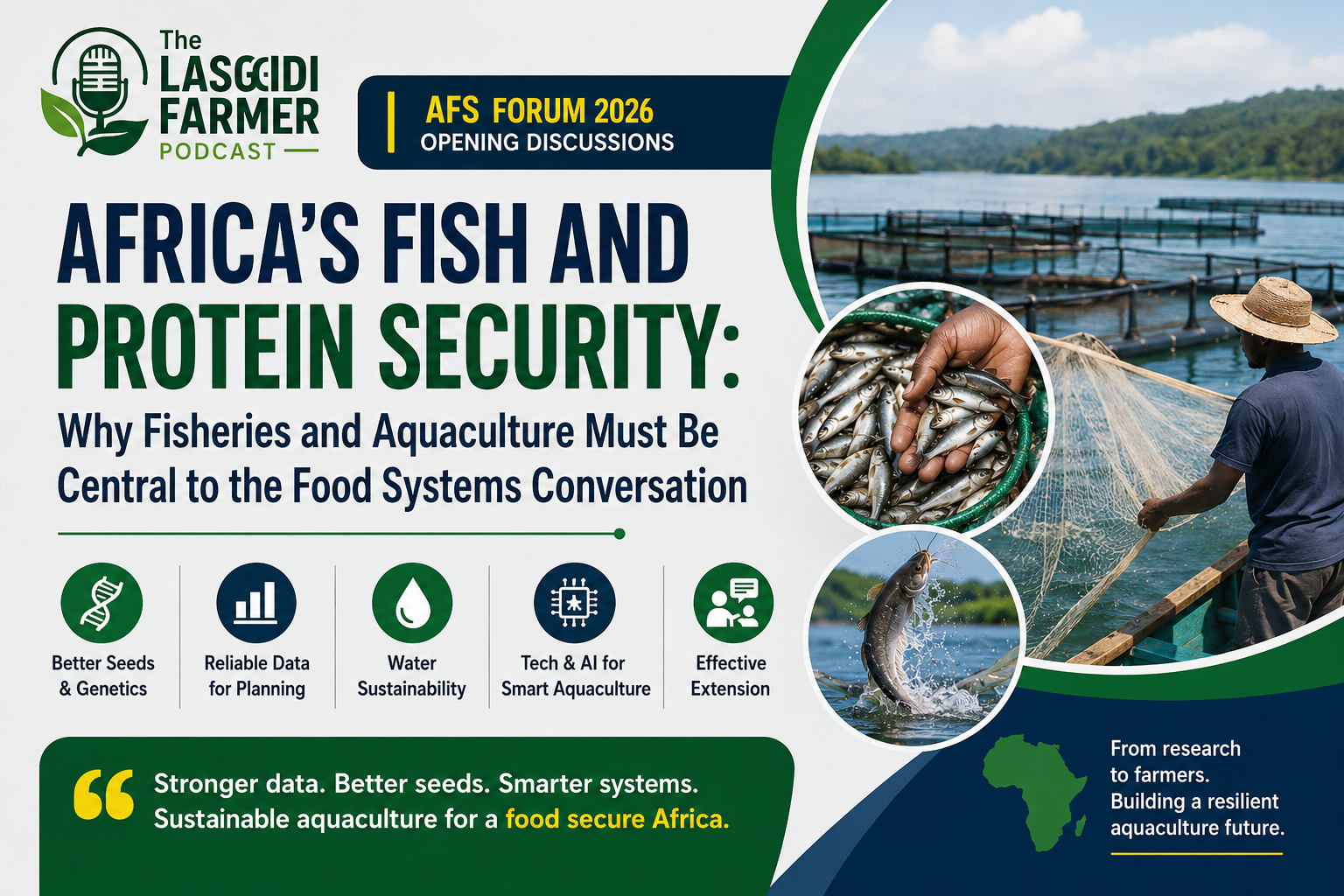
Following the opening discussions of the AFS Forum 2026, one development is particularly encouraging: fisheries and aquaculture are receiving attention within the broader conversation about the future of Africa’s food system.
This matters.
Africa faces a significant fish and aquatic food supply gap, yet fisheries and aquaculture are still too often peripheral to conversations about food security, agricultural transformation and rural development.
At The Lasgidi Farmer Podcast, we believe the sector deserves far greater attention because of its potential contribution to Africa’s protein security, livelihoods, employment and food-system resilience.
The discussions around seed improvement, diversity and commercialization, technology and AI, water-resource sustainability, effective extension, and data policy are especially important.
These are issues that have featured prominently in our conversations and content because they sit at the heart of the challenges and opportunities facing Africa’s aquaculture sector.
The data problem behind the fish supply gap
One of the most fundamental challenges is data.
Africa still lacks sufficiently accurate, timely and comprehensive information on fish production, consumption, demand, seed availability and other critical components of the aquaculture value chain.
Without reliable data, effective planning becomes difficult.
How can the sector accurately determine the quantity and types of fish seed required when reliable information on production levels, farmer demand and consumption patterns remains limited?
The consequences extend beyond planning. They affect investment decisions, breeding programmes, extension services, research priorities and ultimately the sector’s ability to meet growing demand.
Fish seed: an overlooked foundation of aquaculture productivity
The quality and diversity of fish seed are equally important.
Farmers can only achieve so much when the genetic quality of the seed available to them is poor.
Our work and conversations around improving fish breeding in Nigeria have highlighted a troubling reality: poor hatchery practices and limited diversity of parental stocks can contribute to the production of inferior fish seed.
Many hatcheries operate with relatively narrow broodstock pools, while farmers often have limited access to the knowledge and technical support required to make informed decisions about improved seed and production practices.
This points to a larger institutional challenge.
Research, extension and the private hatchery sector need to work much more closely together.
In a conversation with researchers from Nofima, Anna Kristinia and Marie Lillehammer, about localising advanced genetics for Nigerian small-scale hatcheries, the discussion examined one of the major barriers to fish-seed improvement: cost.
One important proposition was that governments can play a catalytic role by supporting partnerships among government, private hatcheries, research institutions and extension systems to build stronger hatchery infrastructure and make improved breeding knowledge more accessible.
This is not simply about producing better fish.
It is about building the foundation for a more productive, resilient and competitive aquaculture industry.
Why are we still so dependent on a few species?
Another question deserves greater attention:
Why should Africa’s aquaculture development continue to depend so heavily on a few species when consumers demand a much wider variety of fish?
In Nigeria, catfish has become particularly dominant because it is relatively hardy, adaptive and familiar to farmers.
But the challenge is not necessarily a lack of interest in other species.
A major constraint is the limited availability of quality seed and practical knowledge for successfully raising alternative species to market size.
This creates a cycle.
Limited seed availability discourages farmers from producing other species. Limited production then reduces commercial incentives to develop the seed market. The result is continued concentration around a few species.
Breaking that cycle requires investment in breeding, research, extension and markets.
Diversifying aquaculture production could also contribute to greater consumer choice and strengthen Africa’s capacity to address its growing protein needs.
Aquaculture cannot be separated from biodiversity and the environment
There is another dimension that deserves much greater attention in food-system conversations: the environmental footprint of aquaculture.
When agricultural impacts on biodiversity are discussed, aquaculture can sometimes be treated as an afterthought.
It should not be.
Aquaculture depends fundamentally on natural resources, particularly water, and poor practices can create environmental and ecosystem risks.
Excessive water exchange, fish escapes, indiscriminate use of antibiotics and the discharge of inadequately treated wastewater can affect surrounding ecosystems and potentially contribute to disease, genetic and chemical risks.
This means the future of aquaculture cannot simply be about producing more fish.
It must be about producing more fish more efficiently, responsibly and sustainably.
Technology and AI can help, but only if they solve real problems
This is where technology becomes particularly important.
Smart technologies, artificial intelligence and digital tools can support aquaculture in several areas, from water management and disease monitoring to farm records, extension delivery, research and decision-making.
Recirculating aquaculture systems, where technically and economically appropriate, can improve water-use efficiency.
Digital applications can also provide farmers with simple, reliable and timely information on production practices, water quality, disease management and other critical decisions.
Technology can additionally strengthen hatchery biosecurity, improve water treatment and monitoring, and reduce risks associated with the discharge of untreated wastewater.
But technology should not become an end in itself.
The real questions should be:
What problem are we solving? For whom? And can the solution work at the scale at which African farmers operate?
The bigger opportunity
The discussions at AFS Forum 2026 reinforce something that deserves greater attention across Africa’s food-system agenda.
Fisheries and aquaculture are not simply another agricultural subsector.
They sit at the intersection of nutrition, protein security, livelihoods, employment, biodiversity, water resources, technology, research, trade and rural development.
If Africa is serious about transforming its food systems, the conversation must move beyond asking how to produce more fish.
We need to ask:
- Do we have the data to understand what the sector actually needs?
- Are we investing sufficiently in improved and diverse fish genetics?
- Are hatcheries receiving the research and extension support they need?
- Are farmers equipped with the knowledge to use improved seed effectively?
- Can technology make aquaculture more water-efficient and environmentally responsible?
- Are markets being developed beyond a few dominant species?
- And are governments, research institutions, private enterprises and farmers working together as one ecosystem?
Africa’s fish supply challenge is also an opportunity.
With the right investments in data, genetics, research, extension, technology, infrastructure and sustainable production systems, fisheries and aquaculture can become much more central to Africa’s food and nutrition security.
The conversation at AFS Forum 2026 is an important step.
But the real test will be what happens after the conversations.
At The Lasgidi Farmer Podcast, we will continue contributing to this conversation by connecting research, policy and real-world agricultural realities, while bringing greater attention to the opportunities and challenges shaping Africa’s food system.